
About the Washtenaw County Clerk Offices
Two separate offices carry the clerk role for Washtenaw County. The first is the Trial Court Records Department, also called Clerk of the Court-Court Services. It keeps the case files for the 22nd Circuit Court, branded locally as the Washtenaw County Trial Court. The second is the elected Washtenaw County Clerk and Register of Deeds, a single official who runs vital records, elections, and recorded land documents. Lawrence Kestenbaum holds that elected post. County election materials and public official listings name him as the current Clerk and Register of Deeds.
The two offices do not overlap much in daily work. Court copies, certified case documents, and case history come from the records department inside the courthouse. Marriage licenses, certified vital copies, notary commissions, and deeds come from the county clerk side. Both operate weekdays in downtown Ann Arbor. The records department handles court files under Michigan court rules, while the elected clerk handles public records under general state law. The office you need depends entirely on the kind of record you are after.
Trial Court Records Department
Office: Clerk of the Court-Court Services
101 E Huron Street, Room 1106
Ann Arbor, MI 48104-1446
734-222-3024
records@washtenaw.org
Monday-Friday, 8:00 a.m.-4:30 p.m.
Two Clerk Offices in Washtenaw County
The split matters because a request sent to the wrong office is a request that goes nowhere. Court records are public unless a statute, court rule, or local administrative order restricts them. The records department states that circuit court records for the last 25 years may be viewed at the main office of Clerk of the Court-Court Services. Public case documents are not posted online, so copies of actual filings come from that department for a fee. The elected county clerk, by contrast, holds the records people often confuse with court files.
Here is how the work divides between the two offices in practice.
- Trial Court Records Department: court case files, register of actions, certified and plain court copies, and in-person case review.
- County Clerk and Register of Deeds: marriage licenses, birth and death certificates, business names, notary commissions, and military discharge papers.
- Register of Deeds side: recorded land documents such as deeds, mortgages, liens, and the online land record search.
- Elections and other services: voter and election functions plus veteran identification and genealogy requests.
Divorce is a useful example of the split. A marriage license and its certified copy come from the vital records office, while the divorce case file lives with the Trial Court family division. The Washtenaw County marriage and divorce records path shows which record sits where. When a record has both a court side and a vital side, you may need to visit both offices to complete one request.
Washtenaw County Clerk and Register of Deeds
Clerk and Register: Lawrence Kestenbaum
Mail: Vital Records, P.O. Box 8645
Ann Arbor, MI 48107-8645
Vital Records hours: Monday-Friday, 8:30 a.m.-4:00 p.m.
Register of Deeds and Vital Records in Washtenaw County
The Register of Deeds keeps every land document recorded in the county. Deeds, mortgages, liens, and similar filings are open to the public. These records surface in civil cases, probate estates, guardianships, divorce property division, and judgment enforcement, so people searching court matters often need them too. The vital records office within the same elected clerk handles certified copies of marriage licenses, birth certificates, death certificates, business names, and military discharge papers. It also runs a secure identification submission site for remote marriage applications.
The county explains its recorded-document search and request process on a single official page.
The county's Search and Request Records page lays out how to look up and order recorded land documents from the Register of Deeds.
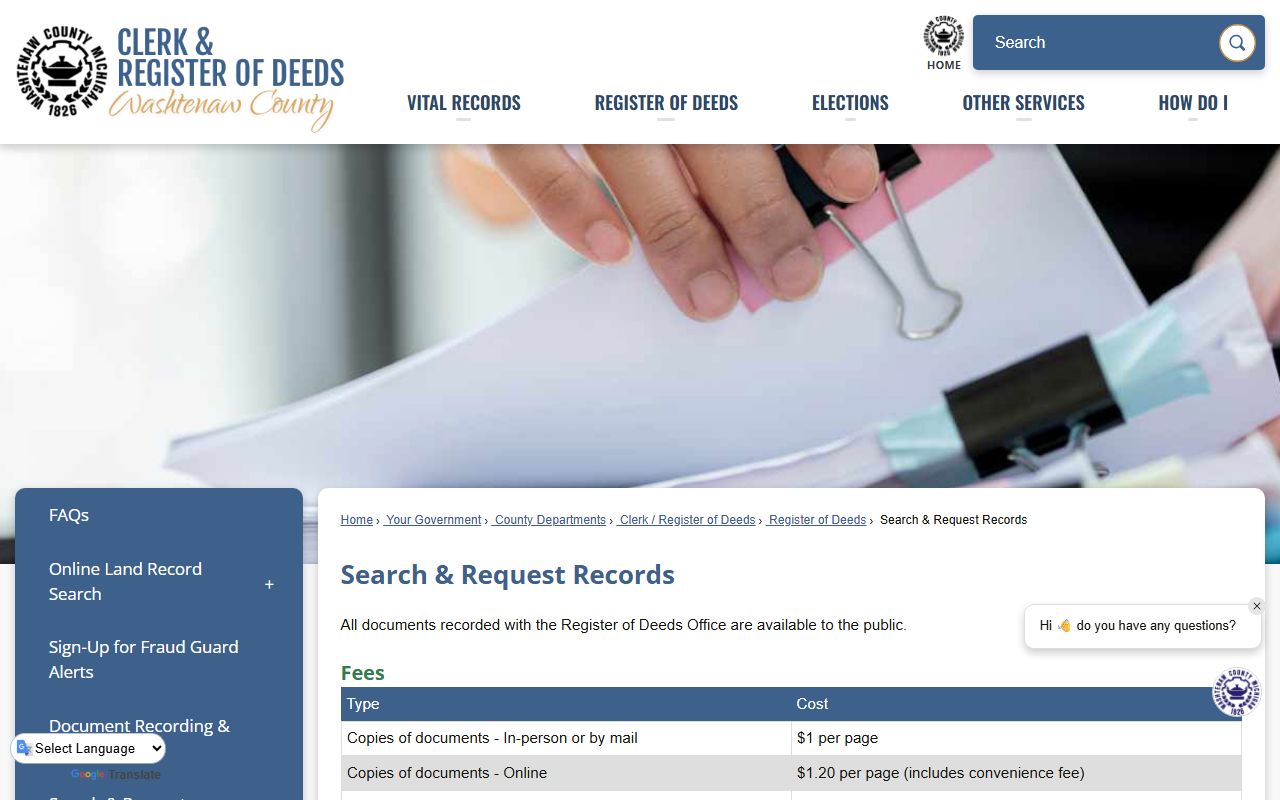
That page confirms all documents recorded with the Register of Deeds are available to the public and links to the online land search. It also points to fraud alerts, recording requirements, eRecording, and the county fee schedule for property filings.
Washtenaw County Land Record Search
Recorded land documents can be searched without a trip downtown. The Online Land Record Search is a self-service portal run by the Register of Deeds. Searching the index and viewing the data carries no charge. The fee to view, print, or save a document image is $1.20 per page. The portal warns that data may change without notice and describes the index as similar to a library card catalogue. Search every possible spelling variation of a name, since a small difference can hide a match.
The portal requires a couple of steps before it opens the search screen.
The Washtenaw County Online Land Record Search asks each user to accept a disclaimer and complete a reCAPTCHA check first.
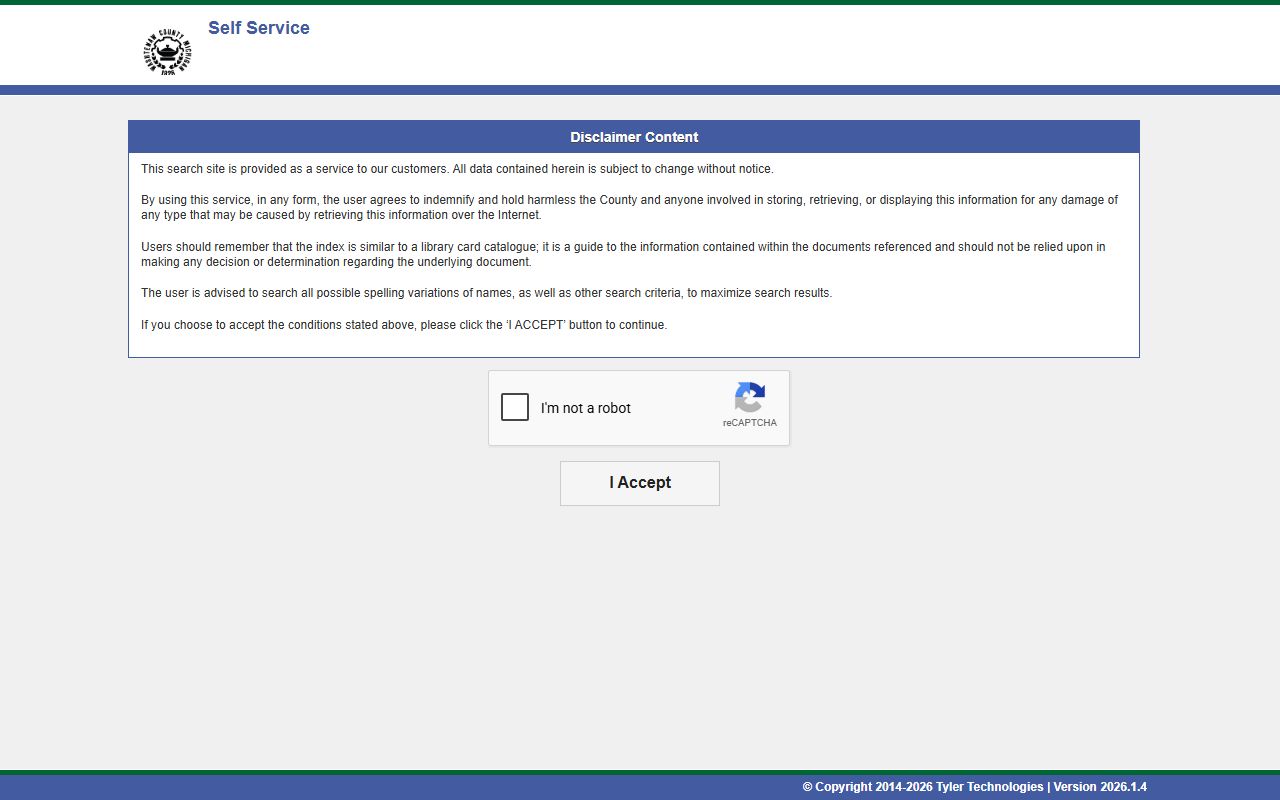
Once inside, the index lets you find a document by name or property detail, then decide whether to pay for the page images. This is the fastest route for a deed or mortgage that does not require a certified court copy.
How to Request a Certified Copy
A certified copy carries the clerk's official mark and is accepted for court and legal use. Plain copies do not carry that mark and may be refused in formal proceedings. For a court case document, the request goes to the Trial Court Records Department. For a marriage record, it goes to the vital records office. The steps below cover the court-copy path, which is the most common certified-copy request tied to a case file.
- Find the case number. Use the county Trial Court Name Search to locate the case by party name, since the number drives every later step.
- Note the document and its date. Read the register of actions, the chronological list of case events, and record the exact filing and date you need.
- Contact the Records Department. Email records@washtenaw.org or call 734-222-3024 with the case number, party names, document, date, and whether you need certification.
- Pay the fee. A certified court copy runs $10 for certification plus $1 per page, and a plain copy is $2 per page.
- Pick up or receive the copy. Review court records in person at Room 1106, or arrange delivery once the department confirms your order.
Court Records Request in Washtenaw County
A clean request moves faster than a vague one. The county instructs requesters to supply four things when ordering a court copy. Each field points the records staff to the exact document among thousands of case files. Missing details slow the order and can lead to the wrong copy. The table lists what to include and why each item matters.
| Field | Required | Notes |
|---|---|---|
| Case Number | Yes | Available through the Trial Court Name Search; it identifies the file. |
| Party Names | Yes | Names of the parties confirm the case and help catch index variations. |
| Document and Date | Yes | The specific filing plus the date listed on the register of actions. |
| Certification Needed | Yes | State whether the copy must be certified for court or legal use. |
The Washtenaw County court records search tools help you gather these details before you contact the department. Once you hold the case number and the register of actions, the order is a short conversation by email or phone.
Note: Court records may be viewed in person at Clerk of the Court-Court Services, 101 E Huron Street, Room 1106, during normal business hours.
Washtenaw County Clerk Fees
Fees differ by copy type and by which office holds the record. Court copies come from the Trial Court Records Department under the Trial Court fee schedule. Land images and certified marriage copies come from the elected county clerk. The amounts below reflect the current county fee snippets for the most common requests. Confirm the figure with the office before you pay, since fee schedules change.
| Item | Amount |
|---|---|
| Normal court copy, per page | $2 |
| Certified court copy | $10 plus $1 per page |
| Exemplified court copy | $10 plus $1 per page |
| Land record index and data search | No charge |
| Land record image, per page | $1.20 |
| Certified marriage copy, first copy | $15 |
| Certified marriage copy, each additional | $5 at same time |
| Marriage license correction | $100 |
Important: Public case documents are not accessible online in Washtenaw County. Online tools help you find the case and its register of actions, but copies of the filings must be ordered from the Records Department for a fee.
Public Access Laws for Washtenaw County Court Records
Access to county records runs on two different tracks. Court files follow Michigan court rules, chiefly Michigan Court Rule 8.119, which places court records with the clerk and controls public access by rule rather than by ordinary open-records process alone. General public bodies, such as the county administration and the sheriff, follow the Michigan Freedom of Information Act instead. That difference is why a court copy request goes to the court and not to a general county FOIA portal.
The statute setting Michigan's open-government policy is short and worth knowing.
The Michigan Freedom of Information Act, MCL 15.231, declares that people are entitled to information about the affairs of government and public officials.
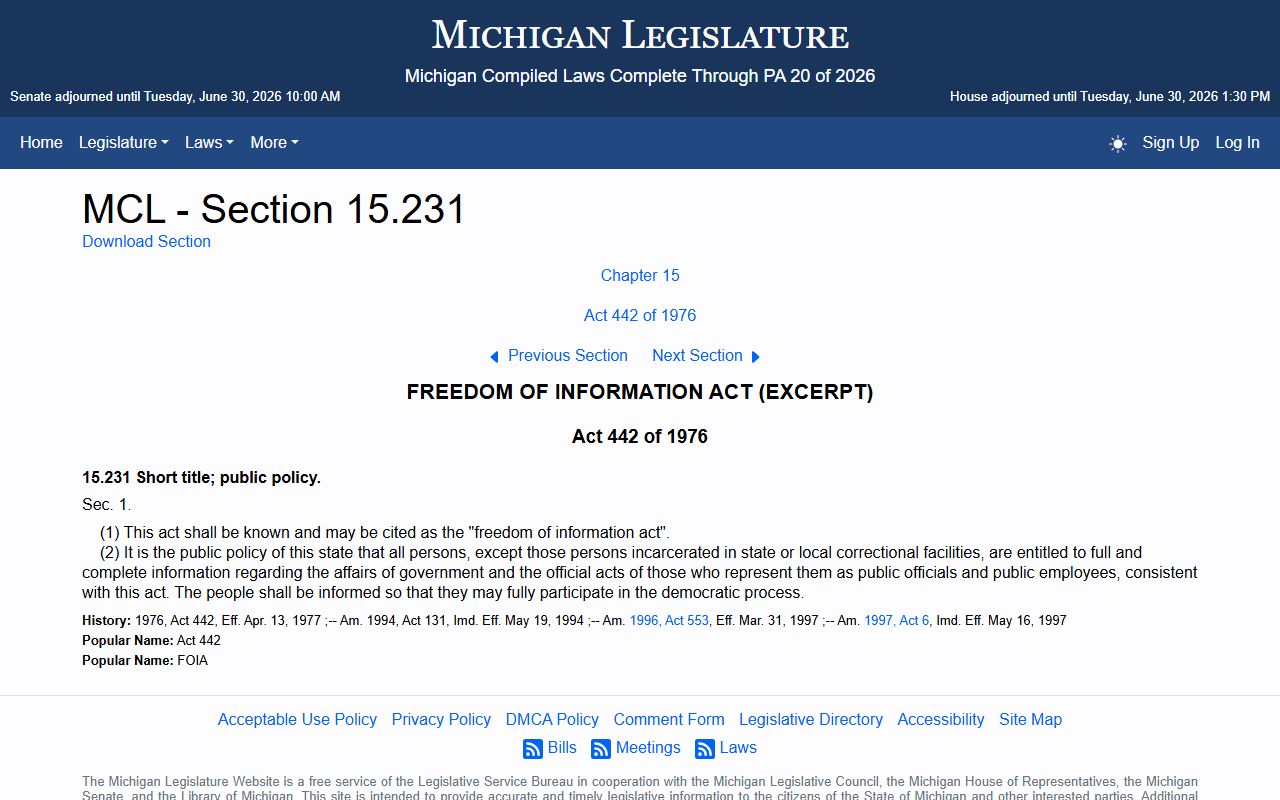
The full act spells out how a request to a public body works, along with the exemptions and fees that can apply. It governs county and sheriff records, not the internal court file process.
Reading the statute alongside the county rules makes the two-track system clearer.
The text of Michigan FOIA, Act 442 of 1976, sets out the procedures a public body must follow when it answers a records request.
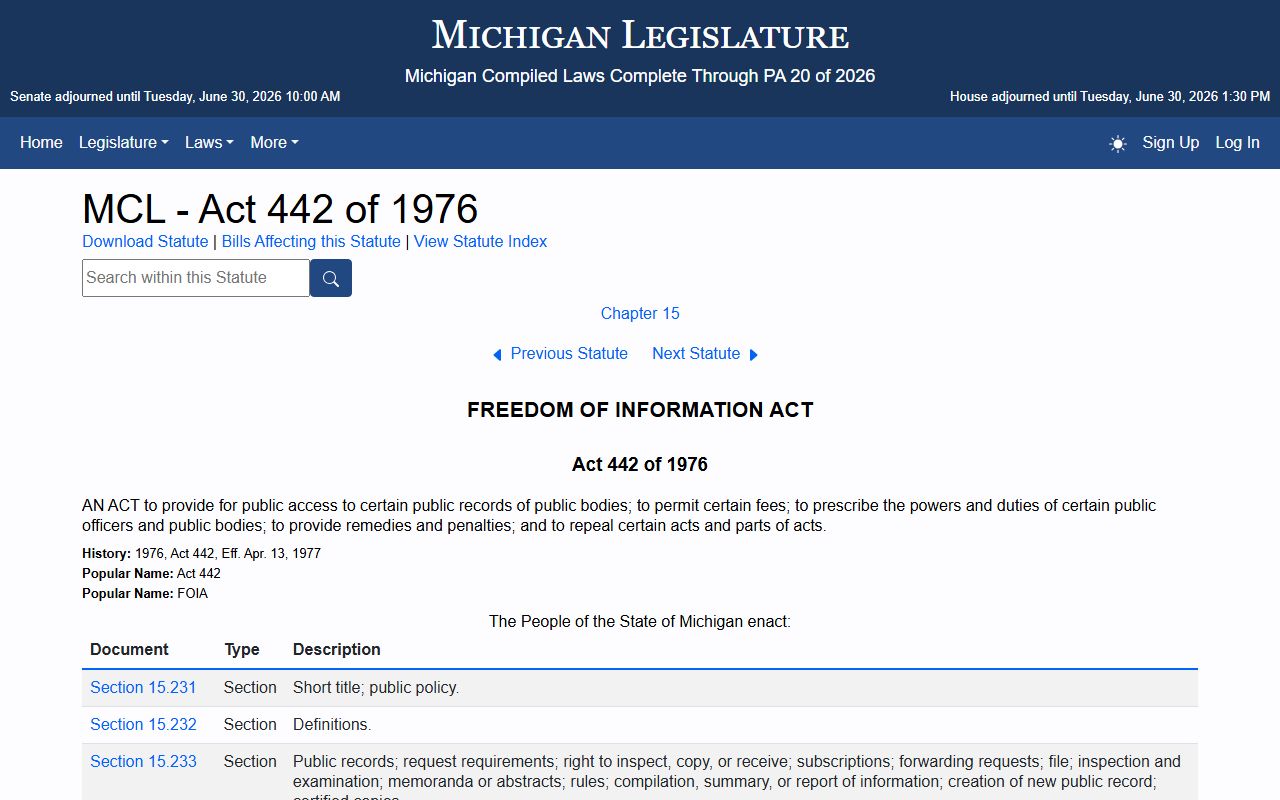
Sheriff reports, jail booking data, and other law enforcement files do not come from the clerk at all. Those go through the Sheriff's Office Records Bureau at 734-973-4655 or the Sheriff's Office FOIA process. Land and marriage records go through the elected clerk and vital records channels. Matching the record to the right office and the right law is the key to a request that actually gets answered.
Note: The county states that court records are public unless a statute, court rule, or local administrative order restricts them, so most case files are open to inspection.