
Criminal Court Records in Washtenaw County
A criminal court record is the official case file the court keeps once the prosecutor files charges. In Washtenaw County the file opens at the court where the case starts and grows with every event. The clerk of the court records each step in a register of actions. This chronological list names the parties, the charges, the hearings, and the judge's orders. Court staff maintain these files, not the police or the jail. The Washtenaw County Trial Court Records Department, part of Clerk of the Court-Court Services, holds circuit criminal files, while each district court keeps its own. Public case data helps locate a case, but the documents themselves are not posted online.
The record tracks the whole life of a case. It captures the charge as filed, any change to that charge, the plea, and the final result. Charges are only the starting point. For a closer look at the charges themselves, the Washtenaw County arrest and court charge records cover the charging document and how counts get amended or dropped.
Washtenaw County Courts That Hear Criminal Cases
Two levels of trial court share criminal work in Washtenaw County. The district courts handle misdemeanors punishable by up to one year in jail. They also hold the first stages of a felony, including arraignment and the preliminary examination, before the case moves up. Three district systems serve the county: the 14A District Court, with locations in Ann Arbor, Ypsilanti, Chelsea, and Saline, the 14B District Court in Ypsilanti Township, and the 15th Judicial District Court in Ann Arbor. The 22nd Circuit Court, branded locally as the Washtenaw County Trial Court, handles felonies and certain serious misdemeanors after the district court binds the case over.
The county Prosecuting Attorney decides which charges to file and appears in both court levels. The office is profiled on the Washtenaw County Prosecuting Attorney page.
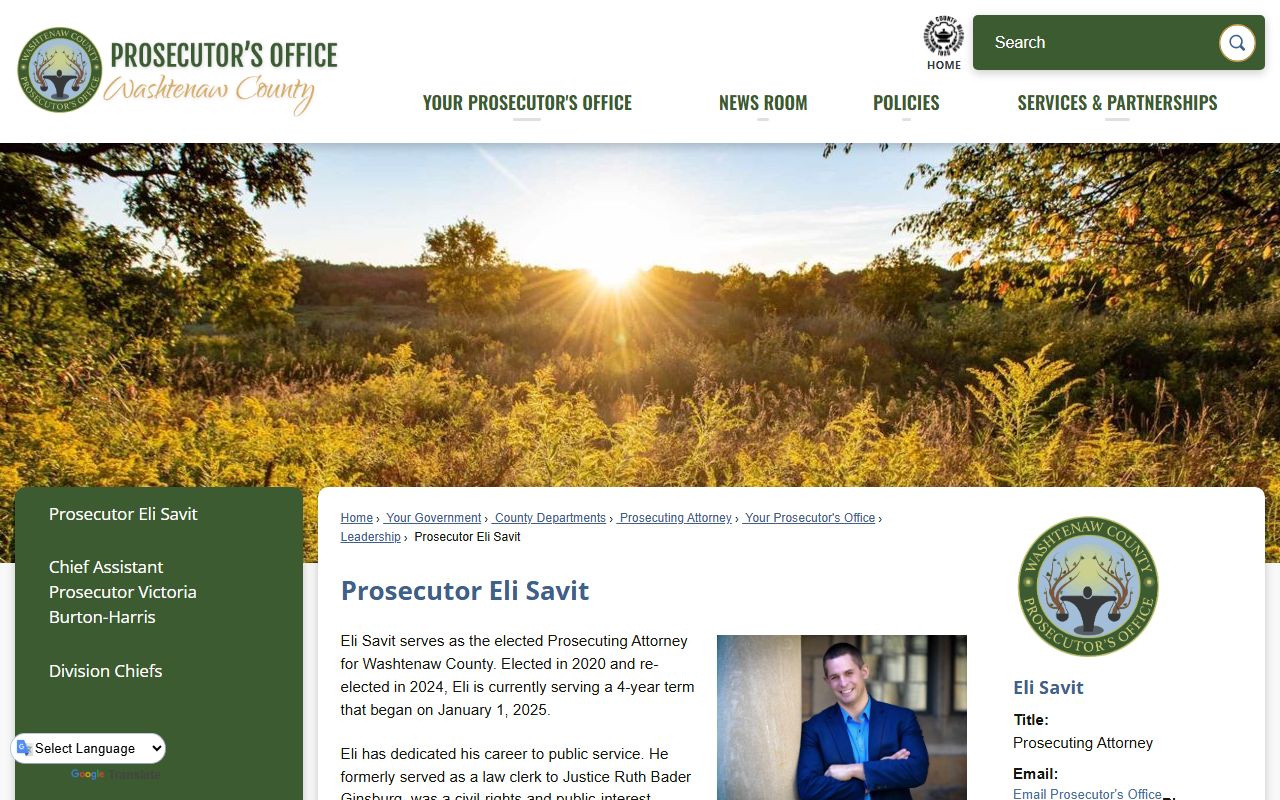
The prosecutor files or authorizes charges on behalf of the People of the State of Michigan, so the office name appears throughout a criminal file. Eli Savit is the elected Prosecuting Attorney. He was elected in 2020 and re-elected in 2024 to a four-year term. The office phone is 734-222-6620. His work reaches district, circuit, probate, and juvenile matters depending on the case.
Savit's background and priorities are set out in the official Eli Savit biography.
Knowing who charged a case helps a reader understand which office to contact about a filing. Defendants who cannot afford a lawyer are represented by the Washtenaw County Public Defender, a county department rather than a private referral list. Its attorneys handle criminal matters, probation violations, personal protection order responses, and legal questions from the public.
How to Search Washtenaw County Criminal Court Records
Public criminal case searching in Washtenaw County runs through a few official systems, not one universal database. The statewide MiCOURT Case Search is the main public path for the Trial Court and the district courts when they participate. The county also offers a Trial Court Name Search for circuit case records. Depending on the court, civil, traffic, criminal, domestic, and probate cases may appear.
- Open MiCOURT Case Search or the county Trial Court Name Search.
- Choose the court, then search by defendant name or case number.
- Narrow the results by case type and date to find the right file.
- Open the case to read the register of actions and the disposition.
- Request a certified copy from the Records Department when a document is needed.
The prosecutor's office can answer questions about a filed charge. Its Your Prosecutor's Office page lists a mailing address, a phone line, and office hours.
Those contact details help when a charge question outruns what the case file shows. For records the office does not release, the court file and the Records Department remain the primary source. Statewide criminal history is separate from a single case file and is handled by the Michigan State Police rather than the county court.
Note: Public online results usually show a register of actions and case events, not downloadable document images, which must be ordered from the court for a fee.
Stages of a Washtenaw County Criminal Case
A criminal case moves through set stages, and each stage leaves an entry in the record. A felony and a misdemeanor follow a similar path, though a felony adds a bindover step. The district court starts most cases, and felonies finish in circuit court.
Case flow: Charges Filed / Complaint › Arraignment (District Court) › Preliminary Exam & Bindover › Circuit Court Pretrial › Plea or Trial › Disposition › Sentencing
At arraignment the court reads the charges, advises the defendant of rights, and sets bond. A defendant who cannot afford counsel may be appointed a lawyer at this stage. Appointed defense in the county is handled through the Washtenaw County Public Defender.
The defender's appearance and each hearing show up as docket entries in the case file. The table below maps each stage to what it adds to the record.
| Stage | What Happens |
|---|---|
| Charges Filed | The prosecutor files a complaint or information and the case file opens. |
| Arraignment | Charges are read, rights are given, a plea is entered, and bond is set in district court. |
| Preliminary Exam & Bindover | A district judge decides whether a felony has enough proof to move to circuit court. |
| Pretrial / Motions | Parties exchange information, argue motions, and discuss a possible plea. |
| Plea or Trial | The defendant pleads, or a judge or jury decides guilt. |
| Sentencing | The judge imposes the penalty after a conviction. |
What a Washtenaw County Criminal Court Record Shows
A Washtenaw criminal file centers on a register of actions rather than downloadable documents. The public search locates the case number and the events tied to it. The file names the parties, lists the charges, and records the outcome. Reading it field by field makes the case easier to follow.
| Field | What It Shows |
|---|---|
| Case Number | The unique number the court assigns to the case. |
| Court and Division | The district or circuit court and the division handling the matter. |
| Defendant | The person charged, with attorney names when listed. |
| Charges | Each offense with its description, MCL statute citation, and count number. |
| Bond | The money or conditions set to secure the defendant's appearance. |
| Plea | The answer to a charge: guilty, not guilty, no contest, or standing mute. |
| Disposition | The final outcome of each charge, such as conviction or dismissal. |
| Sentence | Jail, probation, fines, costs, restitution, and any jail credit. |
Criminal entries can also show an amended charge, a dismissed count, probation events, and warrant activity when public. Docket lines track the complaint, the arraignment, pretrial hearings, motions, orders, the plea, sentencing, and payments. The register of actions ties these events together in date order.
Charges vs Convictions
Being charged is not the same as being convicted. A criminal court record can show charges that were dropped, dismissed, or that ended in acquittal. A charge is an accusation the prosecutor must still prove. A conviction is the court's finding of guilt by plea or verdict. Reading the disposition, not just the charge, tells the real story.
| Charge | Conviction | |
|---|---|---|
| Stage | Accusation | Verdict or plea |
| Burden of Proof | Probable cause | Beyond a reasonable doubt |
| Public Record | Yes | Yes |
Reading Washtenaw County Dispositions and Sentences
Disposition is the final outcome of a charge. Common results include guilty, not guilty, dismissed, and no contest, which Michigan also calls nolo contendere. A charge may end in a plea to a lesser count while other counts are dropped. A dismissal with prejudice generally cannot be refiled. A dismissal without prejudice can be refiled later.
The sentence follows a conviction. It may list jail time, probation, fines, costs, restitution, and credit for days already served. Probation is a supervised sentence served in the community. A problem-solving court such as Recovery Court can shape the disposition through review hearings, sanctions, and graduation, so the docket may note program events alongside the sentence.
Sealed vs Set-Aside Records
Michigan does not use the word expungement in statute. It uses the term set aside. Under the state's Clean Slate framework, an eligible conviction can be set aside and removed from public criminal history and ordinary case display. Sealing restricts a record by law or court order. Law enforcement and the courts may keep access even after a record is set aside.
The set-aside process is governed by state statute. The controlling law is MCL 780.621.
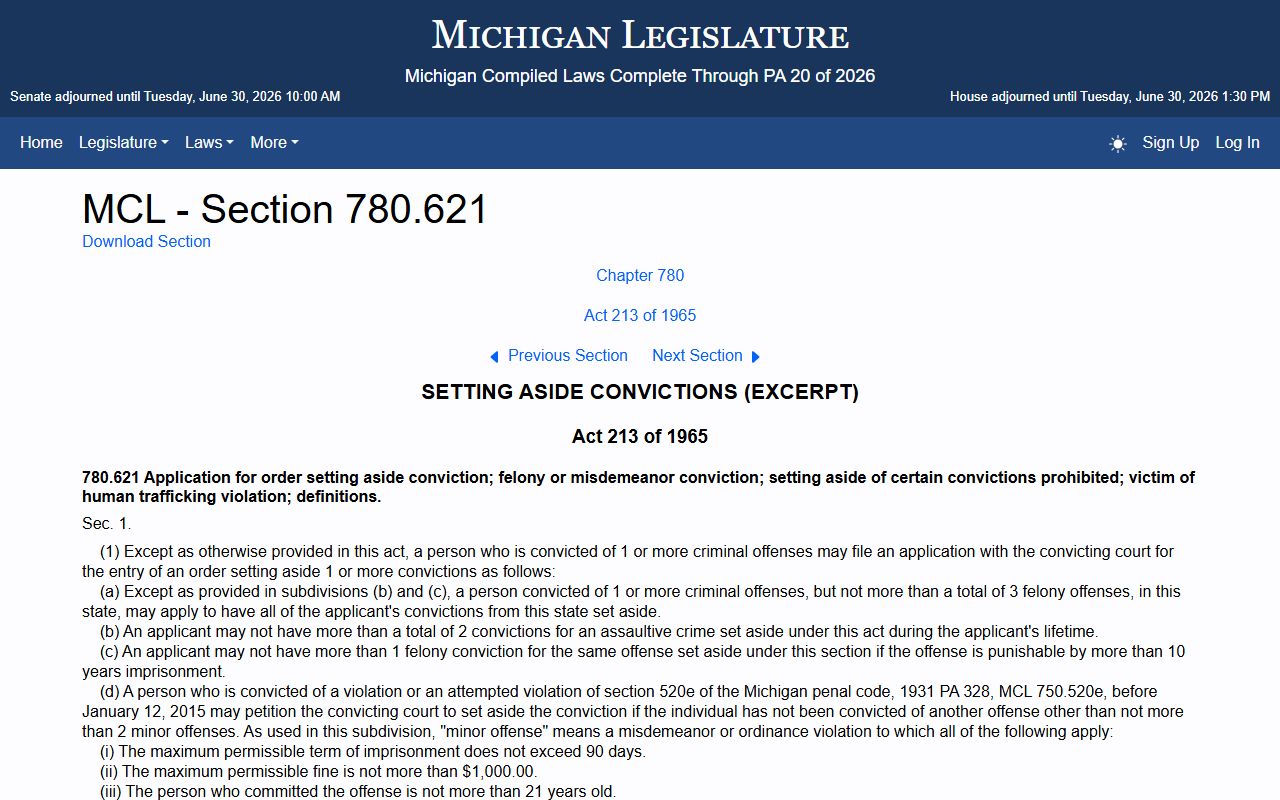
The statute lists which convictions qualify and how the Clean Slate rules apply. The comparison below shows how a sealed record differs from a set-aside conviction.
| Sealed | Set-Aside / Expunged | |
|---|---|---|
| Visibility | Hidden from public view | Removed from public criminal history |
| Law Enforcement | Limited access | Retained access for authorized use |
| Michigan Term | Sealed by law or order | Set aside under Clean Slate |
| Eligibility | Set by statute or court order | Eligible convictions under MCL 780.621 |
Clearing a Washtenaw conviction starts in the court where the conviction was entered.
- Identify the court of conviction: 14A, 14B, the 15th District Court, or the 22nd Circuit Court. A separate application is required for each court.
- Obtain the certified record of conviction and confirm the MCL statute number and disposition.
- Check the waiting periods and eligibility rules under Michigan Clean Slate law.
- File the correct application. Special forms exist for human-trafficking-related and misdemeanor marijuana convictions.
- If the court grants the set-aside, the conviction is removed from ordinary public criminal-history access.
Note: A set-aside record may still exist in some internal government systems, and unpaid restitution can affect automatic set-aside treatment under Michigan law.
Public Access to Criminal Court Records
Michigan court records are public unless a statute, court rule, or local order restricts them. Court access is controlled by the Michigan Court Rules rather than ordinary FOIA. The public search identifies a case, and document copies come from the Trial Court Records Department for a fee. The county states plainly that court records are public unless restricted by statute, court rule, or administrative order.
Statewide criminal history is available separately through the Michigan State Police. The Michigan criminal history and ICHAT service provides public record checks.
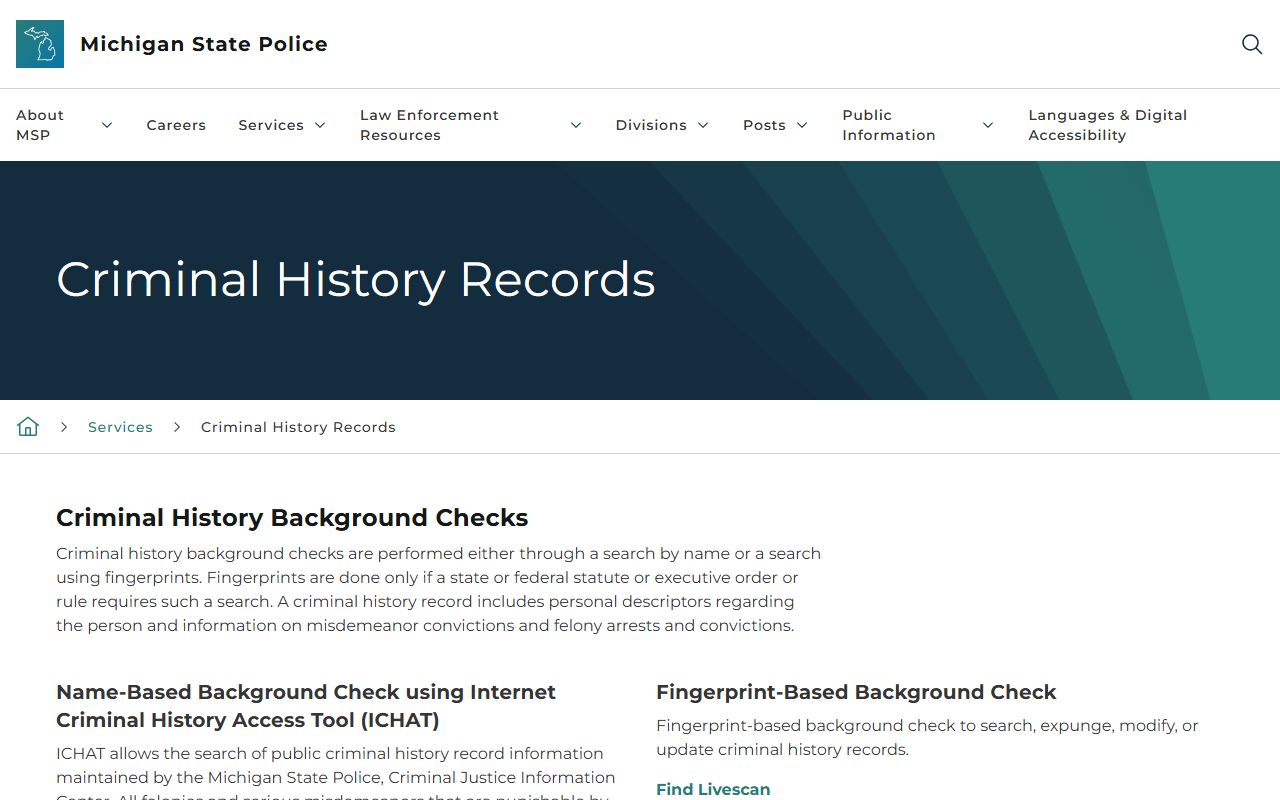
The state notes that suppressed records and warrant information are not available through ICHAT, so a public history check is not a warrant search. A criminal case file and a statewide history report serve different purposes and pull from different systems.
Key Statutes:
Michigan Court Rule 8.119 - Court records are kept by the clerk and public access runs under court rule, not ordinary FOIA.
Michigan Court Rule 1.109 - Defines court records and requires redaction of protected personal identifying information.
Important: This site is a private resource, not an FCRA-regulated consumer reporting agency, and its information may not be used for employment, tenant, or credit decisions.
Restricted Criminal Court Records in Washtenaw County
Some criminal-related records are closed to the public. Juvenile court records are generally nonpublic under MCL 712A.28 beginning January 1, 2021, open only to those with a legitimate interest or by court order. Set-aside and sealed records drop out of ordinary public display under Michigan law. Adoption files, mental health proceedings, and protected personal identifiers such as dates of birth are restricted or redacted. The 15th District public search does not show a date of birth and does not release non-public case information by phone.
Active investigations and sealed warrant material also stay out of public view. For active warrants and the official channels that reveal them, the Washtenaw County warrant records page covers the sheriff and court options.