
Active Warrants in Washtenaw County
A warrant is a court order. In Washtenaw County a judge or magistrate signs one before police may act on it. Arrest warrants usually follow a criminal complaint that the Prosecuting Attorney has reviewed. Bench warrants come straight from the bench, most often when someone misses a court date. Search warrants let officers search a place or person named in the order. Each type begins inside a specific court, and that court keeps the underlying case file.
No confirmed public countywide database lets residents search every active Washtenaw County warrant in one place. That gap shapes how a real search works. The starting point is the public case record, checked through statewide and county case search tools. The court that issued the warrant is the next stop, since bench and failure-to-appear warrants usually begin in a district court. Law enforcement records sit with the Sheriff's Office Records Bureau and its Freedom of Information process. The Sheriff also posts a Most Wanted page and runs a confidential tip line. Absence from a public search does not prove that no warrant exists.
Warrant status can change fast. A judge can recall or quash a warrant the same day a person appears, pays, or resolves the matter. Public case tools do not always reflect that change right away, so a phone call to the issuing court remains the most reliable check.
Types of Warrants in Washtenaw County
Warrants carry different names based on why a court issued them. The label matters because it points to the right court and the right next step. Most Washtenaw County warrants fall into a handful of categories, and each one starts with a signed order from a judge or magistrate.
- Arrest warrant. Issued for a criminal case or complaint, usually after the Prosecuting Attorney reviews the charge.
- Bench warrant. Signed by a judge for a failure to appear, a probation violation, contempt, or failure to comply with a court order.
- Search warrant. Authorizes a search of a place, person, or property under MCL 780.651; the Sheriff's public policy prohibits no-knock search warrants.
- Fugitive warrant or extradition hold. Used when another jurisdiction wants a person held or returned.
- Civil bench or show-cause warrant. Can arise in support, contempt, or other noncriminal proceedings.
The charges behind an arrest warrant are tracked as the case moves. A complaint reviewed by the Prosecuting Attorney can turn into formal counts, and those counts drive the warrant reason and any bond a judge sets.
Washtenaw County Warrant Access Channels
Because no single portal covers every warrant, each channel answers a different question. One shows public court events. Another confirms which court signed the order. A third handles law enforcement records. Reading them together gives the fullest picture of a Washtenaw County warrant.
| Channel | Use | Notes |
|---|---|---|
| MiCOURT / Trial Court case search | Check the public register for warrant-related entries | Sealed and non-public cases are excluded; absence does not mean no warrant. |
| Issuing district court | Confirm bench and failure-to-appear warrants | Contact 14A, 14B, or the 15th District Court based on the court on the notice. |
| Sheriff's Office Records Bureau | Request law enforcement records | Call 734-973-4655 or use the Sheriff's FOIA form for documents. |
| Sheriff's Most Wanted page | View fugitive and public-assistance postings | Confidential tip line 734-973-7711; call 911 for a known location. |
| Michigan State Police ICHAT | Look up public criminal history | Suppressed records and warrant information are not available through ICHAT. |
Note: An attorney can also make a confidential inquiry to a court or the Sheriff, which helps when surrender or bond may be needed.
How to Check a Washtenaw County Warrant
Checking for a Washtenaw County warrant means working the channels in order. Start broad with the public case record, then narrow to the specific court, and reach the Sheriff's Office when law enforcement records are needed. Each step answers part of the question, and no single one is complete on its own.
- Search the public case record. Use MiCOURT case search or the Trial Court name search to look for warrant-related entries on a case. Sealed and non-public cases are excluded, so a clean result is not a guarantee.
- Contact the issuing district court. Bench and failure-to-appear warrants usually start in the 14A District Court, the 14B District Court, or the 15th Judicial District Court. The court named on a ticket or notice controls where to call.
- Ask the Sheriff's Office Records Bureau. Reports and law enforcement records go through the Records Bureau or the Sheriff's FOIA process.
- Check the Sheriff's Most Wanted page and confidential tip line. It lists wanted people; call 911 for a known location.
- Run a Michigan State Police ICHAT search for public criminal history, remembering that suppressed and warrant information is not returned.
Washtenaw County Warrant Search Fields
There is no dedicated warrant portal, so a practical warrant check runs through the court case-search tools. The fields below reflect what MiCOURT and the district court lookups ask for. A last name is the core input, and a case number or date of birth sharpens a common-name search.
| Field Label | Type | Required | Notes |
|---|---|---|---|
| Last Name | Text | Yes | Party-name search on MiCOURT and district court lookups; exact spelling helps. |
| First Name | Text | No | Narrows results for common surnames. |
| Case or Ticket Number | Text | No | Taken from a complaint, ticket, or court notice; points to one case. |
| Court | Dropdown | Conditional | Select the 14A location, 14B, 15th District, or 22nd Circuit Court. |
| Date of Birth | Date | No | Some district lookups use it to confirm identity. |
What a Washtenaw County Warrant Record Shows
A public warrant entry, where one appears, follows the pattern of the case file behind it. The fields below reflect the details commonly tied to a warrant in Washtenaw County court records. Sensitive items may be withheld, and financial fees appear once a warrant is issued.
- Case number
- Links the warrant to the underlying court case.
- Issuing court
- The 14A, 14B, 15th District, or 22nd Circuit Court that signed the order.
- Defendant name
- The person the warrant names.
- Warrant date
- The date the court issued the warrant.
- Warrant reason
- Failure to appear, probation violation, contempt, or a new charge.
- Charge or case type
- The underlying offense or the type of proceeding involved.
- Bond amount
- The set bond, when that detail is public.
- Next hearing
- Any scheduled court date tied to the case.
- Recalled or quashed date
- The date a judge cleared the warrant, if it has been resolved.
- Warrant fee
- The financial charge assessed, such as the district court warrant fee.
Note: Active sealed warrants, juvenile warrants, and search-warrant affidavits may not appear in any public result at all.
Resolving an Outstanding Warrant
An outstanding warrant does not fix itself, and it can lead to arrest at a traffic stop or routine contact. Resolving it starts with finding out which court issued it and why. From there, a clerk or an attorney can explain the options, including bond, a warrant fee, or a walk-in docket.
- Identify the court that issued the warrant using the case number, ticket, police agency, or court notice.
- Check the public case search for hearing history and the issuing court, without assuming that absence from MiCOURT means no warrant.
- Call the court clerk, or have an attorney call, if the risk of arrest is high.
- Ask about bond, the warrant fee, a walk-in docket, arraignment, and whether an attorney appearance can address the warrant.
- If instructed to surrender, appear at the court or jail as directed, and bring ID and a payment method for any bond or fee.
- After a judge recalls or quashes the warrant, confirm the update in both the court and law enforcement systems.
The 15th District Court is direct about the stakes. Its traffic and criminal division states that a failure to appear results in an arrest warrant and a $60 warrant fee. The full case file, including the disposition once the matter is resolved, sits in the Washtenaw County criminal court records.
Important: Talk with a lawyer before you surrender on any warrant. An attorney can confirm the charge, arrange bond, and often address the warrant without a surprise arrest.
Anonymous Tips and Most Wanted
The Sheriff's Office asks the public for help locating wanted people, and it offers a confidential way to share what you know. Tips can be given without leaving a name. For a person actively at a known location, the Sheriff directs callers to 911 rather than the tip line.
The Sheriff maintains a Most Wanted page that lists individuals sought by the county.
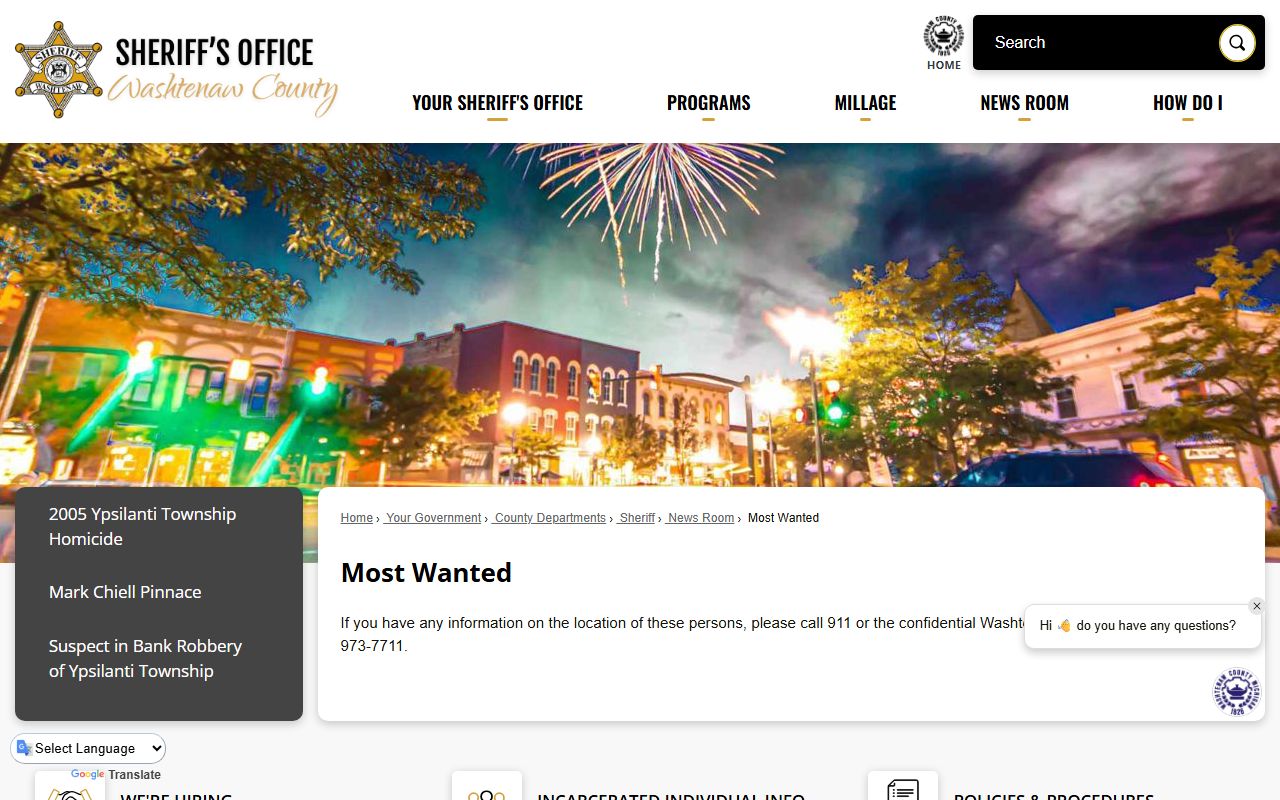
The page pairs each posting with the confidential Washtenaw County Tip Line at 734-973-7711, which takes information on the location of listed persons. That line supports warrant enforcement but does not replace a formal warrant search, and it is separate from the case-search and records channels above.
Restricted Washtenaw County Warrant Records
Not every warrant is open to the public. Michigan law and court rule keep several categories out of ordinary searches, which is another reason a clean result never proves a warrant does not exist. Sealed matters, juvenile cases, and the paperwork behind search warrants are the most common examples.
Juvenile court records are generally nonpublic under Michigan law, so a juvenile warrant will not appear in a routine lookup. Search-warrant affidavits, which explain why a judge authorized a search, are frequently sealed while an investigation is active. The Michigan State Police also notes that suppressed records and warrant information are not returned through ICHAT.
Booking and custody details for someone already arrested on a warrant follow a different track. Those appear through the jail channels described in the Washtenaw County inmate records, including the jail information line. Federal warrants, meanwhile, run through United States agencies rather than the county courts, so they will not surface in a county case search.