
How to Search Washtenaw County Court Records
Washtenaw County does not use one single search box for every court. Washtenaw County court records spread across the county Trial Court and three separate district courts. The state runs a shared public tool called MiCOURT Case Search, and the county runs its own Trial Court Name Search. Both help you find a case number and a list of case events. Neither one hands you document images. Those come from the court records office for a fee.
Before you start, gather what you know. A full legal name helps. A case number helps more. Pick the right court first, since a traffic ticket and a felony rarely sit in the same system. The steps below walk through a basic public search.
- Open MiCOURT Case Search or the county Trial Court Name Search page.
- Choose the court that fits your case, such as the 22nd Circuit Trial Court or a 14A, 14B, or 15th District Court.
- Enter a party name or a case number, and try each spelling variation of the name.
- Narrow the results by case type and date, then open the register of actions to read the docket entries.
- Request a certified or plain copy from the Trial Court Records Department when you need the actual documents.
The Trial Court landing page is the front door to the county's own search and calendar tools. A look at the Washtenaw County Trial Court page shows how the county routes visitors to case search, records requests, and division contacts.
That landing page links to Search Cases and Calendar, which pulls public Washtenaw County Court case records. The fields you meet on the state portal follow a predictable pattern, shown in the table below.
| Field | Type | Notes |
|---|---|---|
| Court selection | Dropdown | Required; pick the specific participating court. |
| Search type | Tab or select | Party name, case number, or attorney search. |
| Party name | Text | Try every spelling; sealed cases stay hidden. |
| Case number | Text | Use the exact court case number when known. |
| Case type | Filter | Civil, traffic, criminal, domestic, or probate. |
| Search | Button | Runs the query and returns matching cases. |
The Washtenaw County Judicial System
Michigan runs three kinds of trial court, and Washtenaw County has all three. The 22nd Circuit Court, branded locally as the Washtenaw County Trial Court, is the broad trial court. It hears felonies, civil suits above $25,000, family matters, juvenile cases, and appeals from the district and probate courts. District courts sit below the circuit court and handle misdemeanors, traffic, small claims, landlord-tenant disputes, and the early stages of felony cases. The Probate Court manages estates, guardianships, conservatorships, and mental health proceedings.
Above the local trial courts sit the state appellate courts. A losing party may appeal up the ladder in a set order. The Michigan Court of Appeals reviews trial court decisions, and the Michigan Supreme Court sits at the top. A simple way to picture the path is a straight line from the bottom court to the highest one.
Case flow: District Court › Circuit Court › Michigan Court of Appeals › Michigan Supreme Court
The statewide view of how these courts fit together appears on the official Michigan Courts site. Its trial court overview lays out the circuit, district, and probate split that shapes every Washtenaw County Court record.
The table below maps the main courts a Washtenaw resident is likely to meet and the cases each one hears.
| Court | Jurisdiction | Case Types |
|---|---|---|
| 22nd Circuit / Trial Court | Countywide | Felonies, civil over $25,000, family, juvenile, appeals |
| 14A District Court | County-operated, four sites | Misdemeanors, traffic, small claims, civil under $25,000 |
| 14B District Court | Ypsilanti Township | Misdemeanors, traffic, landlord-tenant, lower civil |
| 15th District Court | City of Ann Arbor | Traffic, misdemeanors, ordinance cases, felony preliminaries |
| Probate Court | Countywide | Estates, guardianships, conservatorships, mental health |
Each district court keeps its own contact directory. The county district court contacts page lists the phone numbers and addresses that decide where a given file lives.
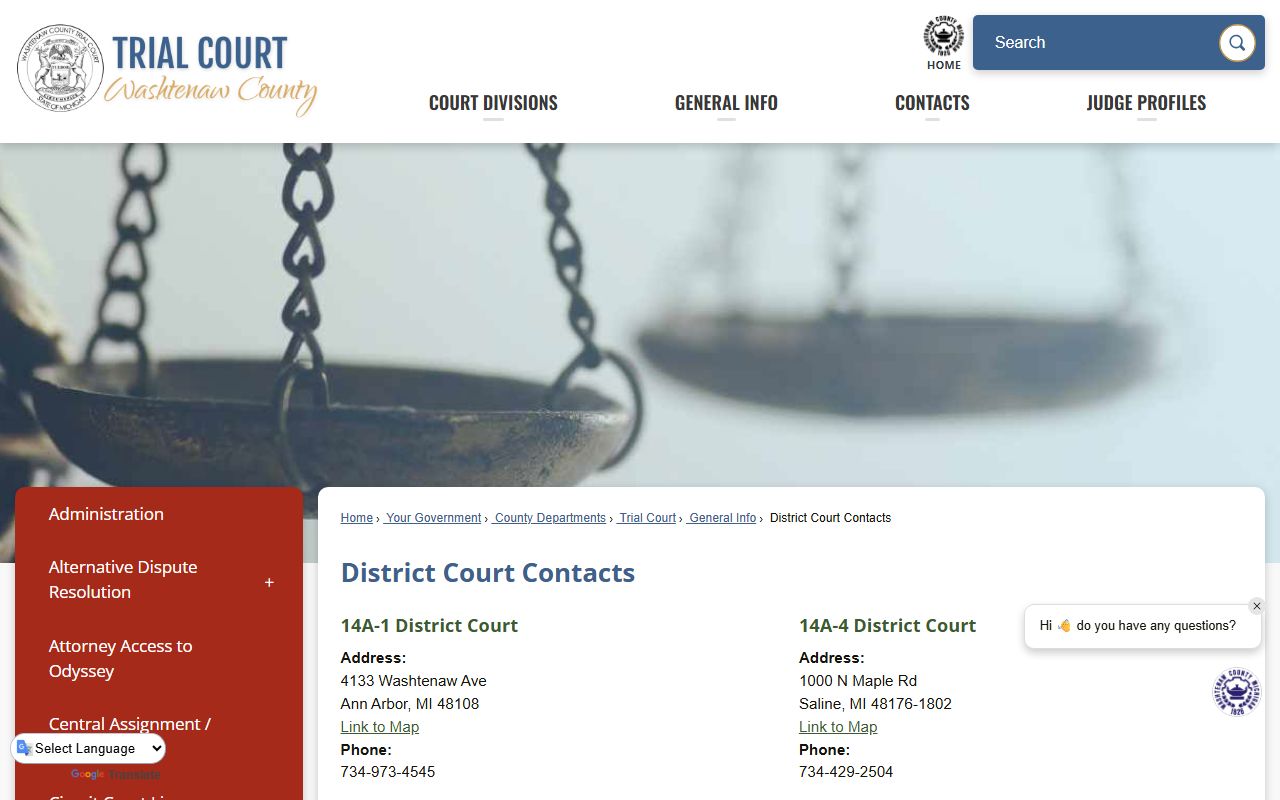
Because Ann Arbor cases often land in the 15th District Court and Ypsilanti Township cases go to the 14B court, checking the contact list first saves a wasted trip.
Washtenaw County Courthouses
Washtenaw County court buildings are spread across several cities, not gathered on one campus. The Washtenaw County Trial Court anchors downtown Ann Arbor at 101 E Huron Street. That building holds the circuit civil and criminal division, the family and juvenile divisions, the Friend of the Court, the Probate Court, jury service, and the records department. District court files, by contrast, may sit miles away in Ypsilanti, Chelsea, or Saline.
The main courthouse handles circuit-level matters and probate. For a traffic ticket or a local misdemeanor, the court named on the citation controls where the record lives. The Trial Court contacts directory gathers the phone numbers, room numbers, and email addresses for every division under one roof. The county Trial Court contacts page is the fastest way to reach the right desk.
Those contacts feed straight into the address cards below, which cover the three court systems residents use most.
Types of Court Records Available in Washtenaw County
Court records in Washtenaw County break down by the kind of case that created them. Criminal, civil, family, probate, traffic, and juvenile files each follow their own rules for content and access. The court that produced a record usually controls it. Felonies live in the circuit court after a district court bindover, while most traffic tickets stay in district court from start to finish.
The civil and criminal division of the Trial Court is the key venue for serious cases. Its civil and criminal division page spells out the jurisdiction, from felonies to civil suits above $25,000. A deeper walkthrough of each type sits on the Washtenaw County court records page.
The list below sorts the main record types a Washtenaw searcher runs into.
- Criminal records - felony files in circuit court and misdemeanors in district court, with charges, pleas, and sentences.
- Civil records - lawsuits, judgments, garnishments, and liens split by the $25,000 dividing line.
- Family and divorce records - divorce, custody, support, name changes, and personal protection orders.
- Probate records - estates, wills, guardianships, and conservatorships from the Probate Court.
- Traffic records - citations, civil infractions, and payable tickets held by the district court on the ticket.
What Washtenaw County Court Records Show
A Washtenaw County public court record centers on a register of actions rather than a stack of downloadable files. The online search points you to the case and its events, but the actual document images are not public online. A typical record still tells you a great deal. It lists the case number, the court and division, the parties, the assigned judge, and every docket entry from filing to disposition.
Criminal files carry extra detail. Expect an offense description, the MCL statute cited, the count number, bond events, plea, any amended or dismissed charge, the conviction, and the sentence. Civil files show the claim type, the pleadings, motions, orders, and the final judgment. The table maps the fields you meet most often.
| Field | What It Shows |
|---|---|
| Case Number | The unique court identifier used to pull the file. |
| Filing Date | When the case opened with the clerk. |
| Parties | Plaintiff and defendant, or petitioner and respondent. |
| Charges / Cause | The offense with MCL citation, or the civil claim type. |
| Disposition | The final outcome of the charge or case. |
| Sentence / Judgment | Jail, probation, fines, or the money award. |
Note: The 15th District Court public search hides the date of birth and will not display non-public cases, so a clean result does not always mean a clean record.
Public Access Laws for Washtenaw County Court Records
Michigan treats court records and general government records under different rules. County records like sheriff reports fall under the state Freedom of Information Act. Court case files answer to the Michigan Court Rules instead. The county itself states that court records are public unless a statute, court rule, or local administrative order closes them. That means the path to a court file runs through the court, not a broad FOIA portal.
Court operations, from public counters to ADA accommodations and interpreters, are managed as Trial Court services. The county Court Operations page gathers the rules that govern in-person access and screening.
The statutes and court rules below set the frame for what stays open and what stays closed.
Key Statutes:
Michigan FOIA, MCL 15.231 - Declares that people are entitled to information about public bodies and government affairs.
MCR 8.119 - Puts court records in the hands of clerks and sets public access by court rule, not ordinary FOIA.
MCR 1.109 - Defines court records and requires redaction of protected personal identifying information.
Set-aside, MCL 780.621 - Lets eligible adult convictions be set aside under Michigan's Clean Slate framework.
Juvenile records, MCL 712A.28 - Keeps juvenile court records generally closed except to those with a legitimate interest or a court order.
Records That Are Restricted or Confidential
Not every Washtenaw County court file is open to the public. Some records stay closed by law from the day they are created, and others get sealed later. Juvenile court records are generally nonpublic under state law and open only to people with a legitimate interest or a court order. Adoption files, mental health proceedings, and set-aside convictions also sit outside ordinary public view. Court rules further strip out private details like Social Security numbers, account numbers, and dates of birth.
A person who wants to clear an old Washtenaw conviction usually files in the court that entered it. That could be the 14A, 14B, 15th District Court, or the 22nd Circuit Court. The applicant obtains the certified record of conviction, confirms the statute and disposition, and checks the waiting period under Clean Slate law. If the court grants the set-aside, the conviction drops out of ordinary public criminal history, though internal government systems may still hold it. Unpaid restitution can block an automatic set-aside.
Circuit, District, and Probate Courts Compared
Washtenaw County's three trial courts differ in what they hear and where their records sit. A quick comparison helps a searcher aim at the right office on the first try. The circuit court owns the heavy cases and the appeals. District courts own the high-volume daily cases like tickets and misdemeanors. The probate court owns the paperwork of estates and guardianships.
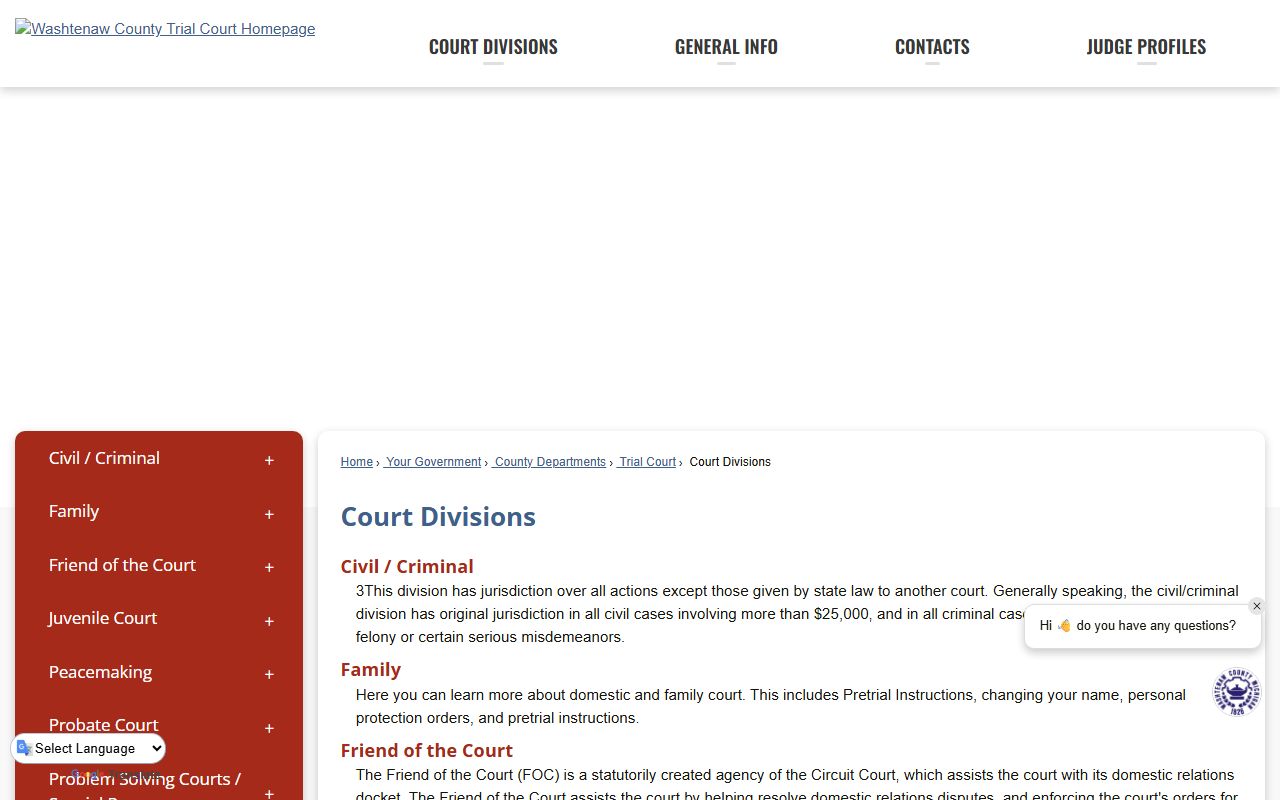
Each Trial Court division has its own mission, from Peacemaking to the Friend of the Court. The official court divisions page describes what each division does and where it fits.
The table lines up the three courts side by side.
| Feature | Circuit Court | District Court | Probate Court |
|---|---|---|---|
| Main cases | Felonies, civil over $25,000, family | Misdemeanors, traffic, small claims | Estates, guardianships, mental health |
| Where records sit | 101 E Huron Street, Ann Arbor | 14A, 14B, or 15th District sites | 101 E Huron Street, Room 1104 |
| Online search | MiCOURT and county Name Search | MiCOURT and court-specific tools | MiCOURT where available |
| Appeals go to | Michigan Court of Appeals | Circuit Court | Circuit Court |
Specialty Courts in Washtenaw County
Washtenaw County runs several problem-solving courts that steer people toward treatment instead of standard sentencing. The Trial Court's Problem-Solving Courts division oversees Recovery Court, Family Treatment Court, and the Specialized Alternative to Sentencing Support program, known as SASS. These are court-supervised tracks, not separate record vaults. A participant still has a public criminal or family case, but the program shapes the hearings, sanctions, and final disposition.
Recovery Court is an 18-month program with five phases aimed at nonviolent adults with substance use disorders. General eligibility includes being at least 18, living in Washtenaw County, and facing charges tied to substance use. Family Treatment Court is a voluntary 12-month, four-phase program built around family reunification and treatment. Because its files can hold sensitive family and juvenile information, access is tighter than an ordinary civil case.
The county also uses Peacemaking, a restorative approach drawn from Native American tradition that focuses on healing and repairing relationships. It gives everyone a role in a shared solution rather than a purely adversarial hearing. For a participant, program milestones may appear in the docket entries and orders of the underlying case when those events are public.
Washtenaw County Sheriff and Jail
The Washtenaw County Sheriff's Office runs the county jail from its Service Center at 2201 Hogback Road in Ann Arbor. Sheriff Alyshia Dyer leads the office. The Corrections division handles custody, court security, and community programs. One detail catches many people off guard. Washtenaw does not publish a searchable public jail roster online. Instead, the jail directs the public to call 734-973-4770 for bond information, charge information, and visitation details on a specific person.
That phone line is the main way to confirm whether someone is held and on what terms. For sentenced state prisoners, the Michigan Department of Corrections OTIS system covers custody instead of the county jail. The full roster process, mail rules, and visitation windows appear on the Washtenaw County inmate records page, and active warrant channels are covered under warrant records since no countywide warrant database was confirmed.
Marriage, Divorce, and Probate Court
Marriage, divorce, and probate records travel through different doors in Washtenaw County. Marriage licenses and certified marriage copies come from the County Clerk / Register of Deeds Vital Records office. Divorce case files are family division court records at the Trial Court, while certified divorce certificates come from Michigan state vital records. Probate matters run through the Probate Court in Room 1104 of the county courthouse. Details for each track live on the marriage and divorce records page and the probate records page.
Probate paperwork uses terms that trip up first-time filers. A short glossary clears up the roles.
- Testator
- The person who made a will.
- Executor
- The personal representative who settles an estate.
- Conservator
- Someone appointed to manage another person's property and money.
Washtenaw County Court Records Fees
Copies of Washtenaw County court records carry set fees, and the price depends on whether you need a plain copy or a certified one. The Trial Court Records Department fills these orders. Public case documents are not free to download online, so a copy request is the normal path to the actual paperwork. Land record images from the Register of Deeds follow a separate per-page rate.
The table below lists the current court copy fees drawn from the county fee schedule.
| Item | Amount |
|---|---|
| Normal court copy per page | $2 |
| Certified court copy | $10 plus $1 per page |
| Exemplified court copy | $10 plus $1 per page |
| Land record image (view/print/save) | $1.20 per page |
| First certified marriage copy | $15 |
The Trial Court fee page and the records request page spell out how to order and what to include.
How to Interpret Washtenaw County Court Records
Washtenaw County court dockets read like shorthand, and the abbreviations throw off many first-time users. A charge is only an accusation, not proof of guilt. A conviction is the finding that follows a plea or a verdict. Knowing that gap keeps a reader from misjudging an open case. Disposition codes tell you how a charge ended, whether by plea, dismissal, or sentence.
A short set of definitions covers the terms that appear most in a Washtenaw file.
- Arraignment
- The first hearing where charges and rights are addressed.
- Bindover
- Transfer of a felony from district court to circuit court after preliminary proceedings.
- Nolle prosequi
- The prosecutor's formal decision not to pursue a charge.
- Register of Actions
- The chronological list of every event in a case.
Accuracy and Record Limitations
Washtenaw County case data lags behind the courtroom. A plea entered this morning may not show up in the public search until clerks post it. Records can also carry typos, name mix-ups, or missing events. Sealed and set-aside cases drop out of public view entirely, so an empty result is not proof that nothing exists. When a detail matters, confirm it with the court that holds the file.
Note: Always confirm a case number, charge, or disposition with the Trial Court Records Department before relying on an online result for any legal or financial decision.
History of Washtenaw County Courts
Washtenaw County was authorized in 1822 and organized in 1826, with Ann Arbor as the county seat from the start. The court tradition is older than the current building at 101 E Huron Street, and earlier courthouses stood downtown before the modern complex. Over time the state split trial work into circuit, district, and probate lanes, which is why residents now deal with three district systems plus the circuit court.
The county also modernized how it runs cases. The Trial Court's Central Assignment office was built in 1988 after a reorganization plan, and it handles scheduling and case evaluation. Today the same court uses Odyssey for attorney access, MiFile for e-filing, public case search, courtroom streaming, and online payment tools. The University of Michigan, Eastern Michigan University, and Washtenaw Community College all feed the local caseload, shaping traffic, landlord-tenant, and misdemeanor dockets.
Frequently Asked Questions
Where do I search Washtenaw County Court records for free?
Two free tools cover most needs. The statewide MiCOURT Case Search reaches participating courts, and the county Trial Court Name Search covers Washtenaw circuit-level cases. Both return a case number and a list of case events. Neither one lets you download the actual documents. For those, order copies from the Trial Court Records Department for a fee.
Why can't I find a Washtenaw jail roster online?
Washtenaw County does not publish a searchable public jail roster on its website. The Sheriff's Office directs the public to call 734-973-4770 for bond, charge, and visitation details on a specific person. For sentenced state prisoners, use the Michigan Department of Corrections OTIS system instead of the county jail line.
How do I check for a warrant in Washtenaw County?
No single countywide warrant database was confirmed. Start with the public case search for warrant-related entries, then contact the district court that issued the case. The Sheriff's Records Bureau, the Most Wanted page with tip line 734-973-7711, and the state ICHAT system round out the options. A failure to appear in the 15th District Court triggers a warrant and a $60 fee.
Are Washtenaw County Court documents available online?
Public case documents are not accessible online through the county Trial Court search. The online tools show a register of actions, not PDF images. To get the actual filings, order plain, certified, or exemplified copies from the Records Department. A normal copy runs $2 per page, and certified copies cost $10 plus $1 per page.
Which court handles my traffic ticket?
The court printed on the ticket controls it. Ann Arbor cases usually go to the 15th District Court, Ypsilanti Township cases go to the 14B court, and other areas route to a 14A location in Ann Arbor, Ypsilanti, Chelsea, or Saline. Confirm the court before driving downtown, since the county courthouse rarely handles routine traffic.
How do I get a certified marriage or divorce record?
Certified marriage copies come from the County Clerk / Register of Deeds Vital Records office, with the first copy at $15. Divorce case files are family division court records at the Trial Court, but a certified divorce certificate comes from Michigan state vital records. Choose the office based on whether you need the case file or the certificate.