
What Washtenaw County Probate Records Cover
The Washtenaw County Probate Court is a division of the Washtenaw County Trial Court. It hears estates, guardianships, conservatorships, mental health cases, registration of foreign births, and wills. Michigan runs three trial courts: circuit, district, and probate. Probate is the one that settles estates and orders legal protection for adults and minors. It is not a surrogate court or an orphans court. Those titles belong to other states.
Probate records show the legal life of an estate or a protective case. An estate file can hold the will, the inventory, letters of authority, notices, accountings, and the final distribution. A guardianship or conservatorship file names who was appointed and what powers they hold. Many estate records stay open to the public. Mental health details and some guardianship information stay restricted by law.
The county describes each of these case types on its Probate Court page.
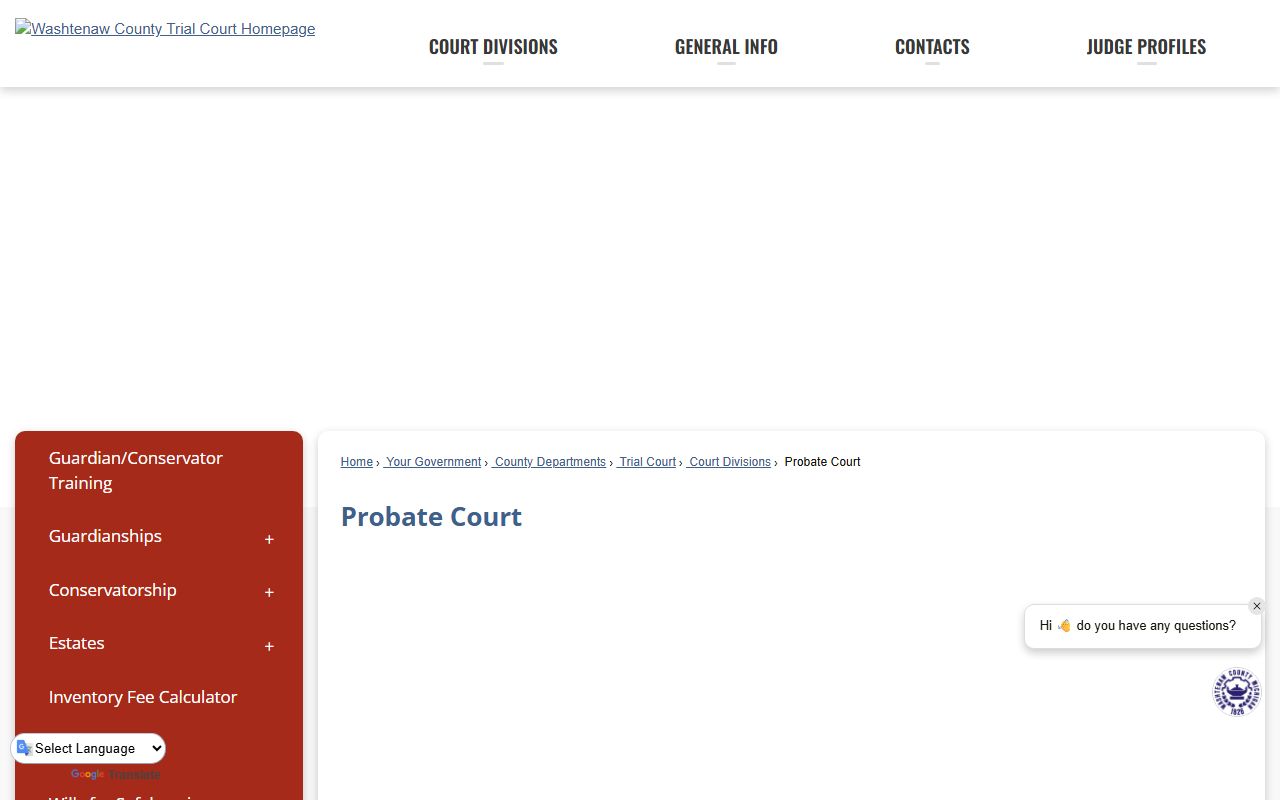
That division menu gathers estate, guardianship, conservatorship, and wills resources in one place, which makes it a good first stop before a filing.
Contacting the Washtenaw County Probate Court
The Probate Court sits inside the main courthouse in downtown Ann Arbor. Staff answer questions about filings, forms, and copies at the counter. The office keeps standard weekday hours. Mental health case details are not given out over the phone, so plan those requests through the proper channel.
Use the contact card to reach the court before a visit. A quick call or email can confirm which form a case needs and what a copy will cost.
Washtenaw County Probate Court
101 E Huron Street, Room 1104
Ann Arbor, MI 48104-1446
734-222-3072
Monday to Friday, 8:00 a.m. to 4:30 p.m.
Probate Terms Defined
Probate files use a set of legal words that shape every case. Reading a register of actions is far simpler once these terms are clear. The list below covers the ones that come up most often in Washtenaw estates and protective cases.
- Testator
- The person who made a valid will before death.
- Personal representative
- The person the court authorizes to administer an estate, gather assets, and pay debts.
- Executor
- A personal representative named in the will to carry out its terms.
- Intestate
- Dying without a valid will, so state law decides who inherits.
- Estate
- The property, debts, and assets a person leaves behind at death.
- Guardianship
- A court order giving one person authority over another's health and personal decisions.
- Conservatorship
- A court order giving one person authority over another's property and money.
Estate Types in Washtenaw County Probate
Estate administration confirms who may act for a person who has died. That authority lets someone gather assets, pay expenses and creditors, file an inventory, distribute property, and close the estate. Michigan sorts estates into three main paths. The right path depends on the estate value and whether anyone disputes the case.
Formal estates involve judicial determinations. A judge steps in when there are disputes, unclear heirs, or contested documents. Informal estates are administrative filings that move without a contested hearing when the requirements are met. Small estates use simplified procedures for lower-value estates that fit the statutory limit.
An estate filing usually needs a certified death certificate, which comes from the county clerk rather than the Probate Court. That vital-records path is covered with Washtenaw County marriage and divorce records, since the same office keeps birth and death files.
Small Estates and the Michigan Threshold
Small estates offer the quickest route through probate. Michigan sets a value limit that changes with the law and inflation. Michigan Legal Help states that for a person who died in 2026, the estate must be worth $53,000 or less to use the small estate process. The 2025 figure was $51,000. Because the number moves each year, confirm the current threshold before filing.
State law authorizes the simplified handling of these estates. The small estates statute, MCL 700.3982, lets the Probate Court assign qualifying small estates without full administration.
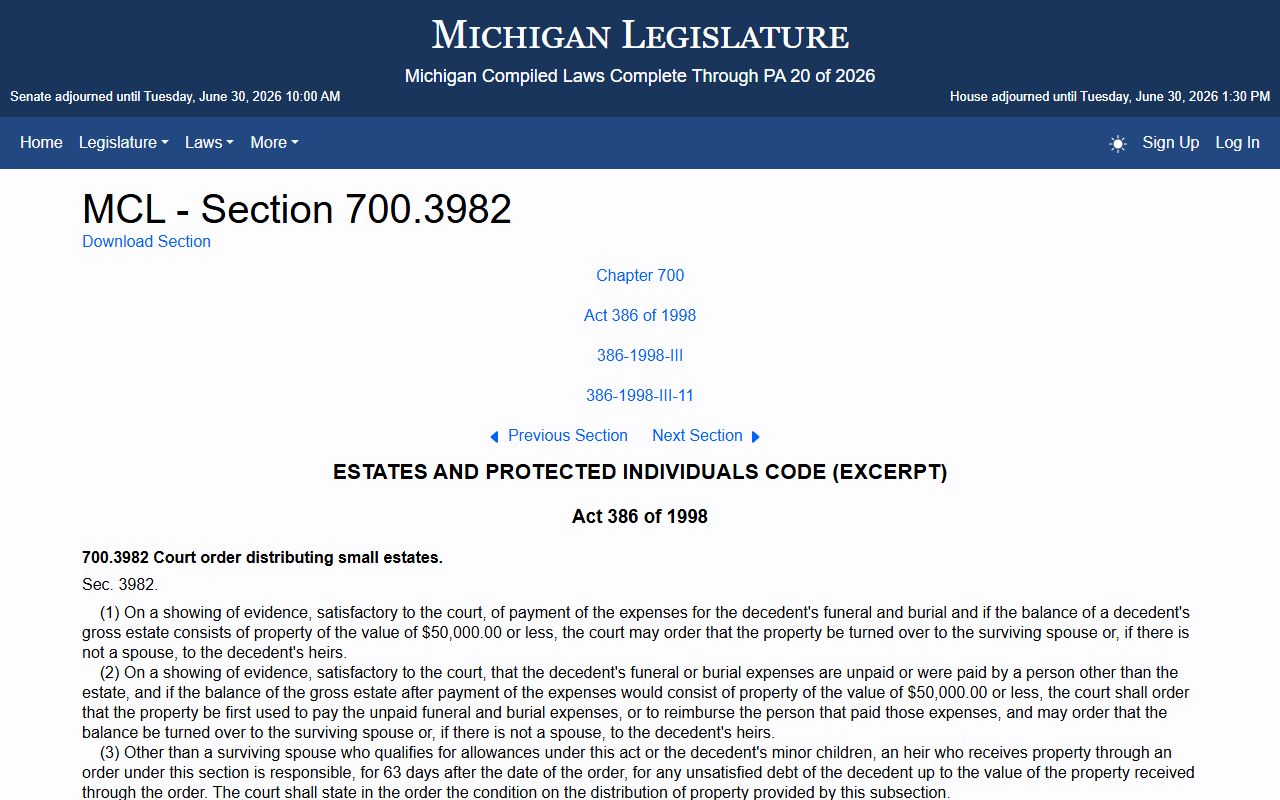
Reading the statute helps a filer see which assets and values qualify before choosing the small estate track over formal or informal administration.
Wills for Safekeeping in Washtenaw County
Michigan lets a living person deposit a will with the Probate Court for safekeeping. This keeps the original document secure and easy to locate after death. A $25 filing fee is required to deposit a will this way. The court stores the document on its premises.
A deposited will is not a public record while the maker is alive. It can be retrieved and opened only under the court's rules, which protect the maker's privacy and control.
The county explains the deposit process on its Wills for Safekeeping page.
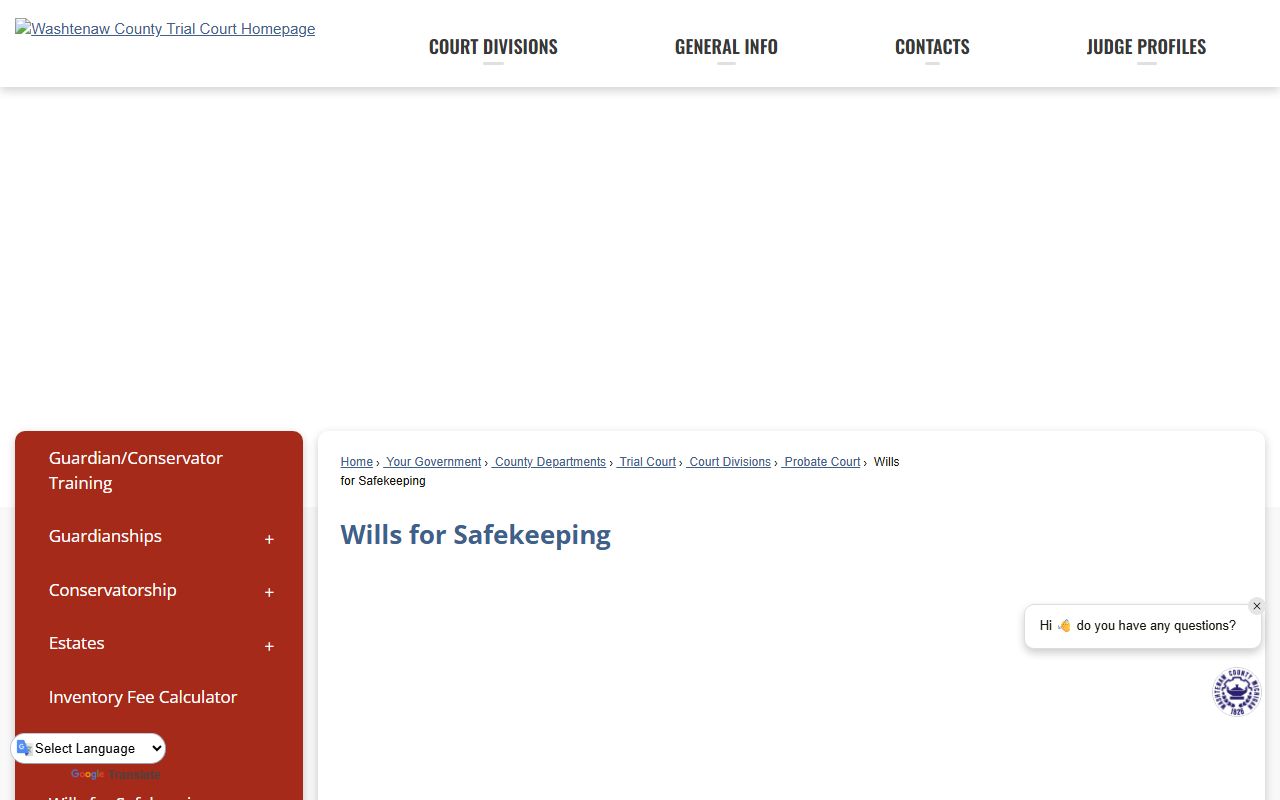
That page lays out the fee and the storage terms, which matters for families trying to find whether a loved one left a will on file.
Guardianships and Conservatorships
Guardianships and conservatorships protect people who cannot fully care for themselves. The two roles are not the same. A guardian makes health and personal decisions for the protected person. A conservator manages that person's property and money. One case can involve both roles or just one.
The Probate Court keeps separate resources for legally incapacitated adults, developmentally disabled adults, and minors. It also handles adult conservatorship, minor conservatorship, and guardian or conservator training. Michigan Legal Help notes that probate courts appoint guardians and conservators for both incapacitated adults and minors. Some of these files carry restricted details, especially where a minor or a health condition is involved.
How to Search Washtenaw County Probate Records
Probate searches use several channels, since the court does not post case documents online. Start by confirming the case belongs in Washtenaw County. Then work through the public portal, the court counter, and the forms library in turn. The steps below move from the easiest option to the most hands-on.
- Confirm the decedent lived in Washtenaw County or owned property that requires local probate.
- Try the MiCOURT Case Search portal, which may show probate cases when the court participates.
- Visit the Probate Court counter in Room 1104, or the Trial Court Records Department, to view files and request copies.
- Call 734-222-3072 or email probate@washtenaw.org for help with a specific case or filing.
- Download the matching SCAO forms from the Michigan Courts forms library before you file.
Note: Public probate documents are not available online, so the case search locates the case number and events while the actual copies come from court staff.
Washtenaw County Probate Court Fees
Probate costs fall into a few groups: the deposit fee for a will, the inventory fee tied to estate value, and the standard copy charges. The inventory fee is not a flat number. It scales with the value of the estate reported on the inventory form.
Michigan provides an official tool to work out that figure. The Michigan Courts inventory calculator returns the fee once you enter the inventory value.
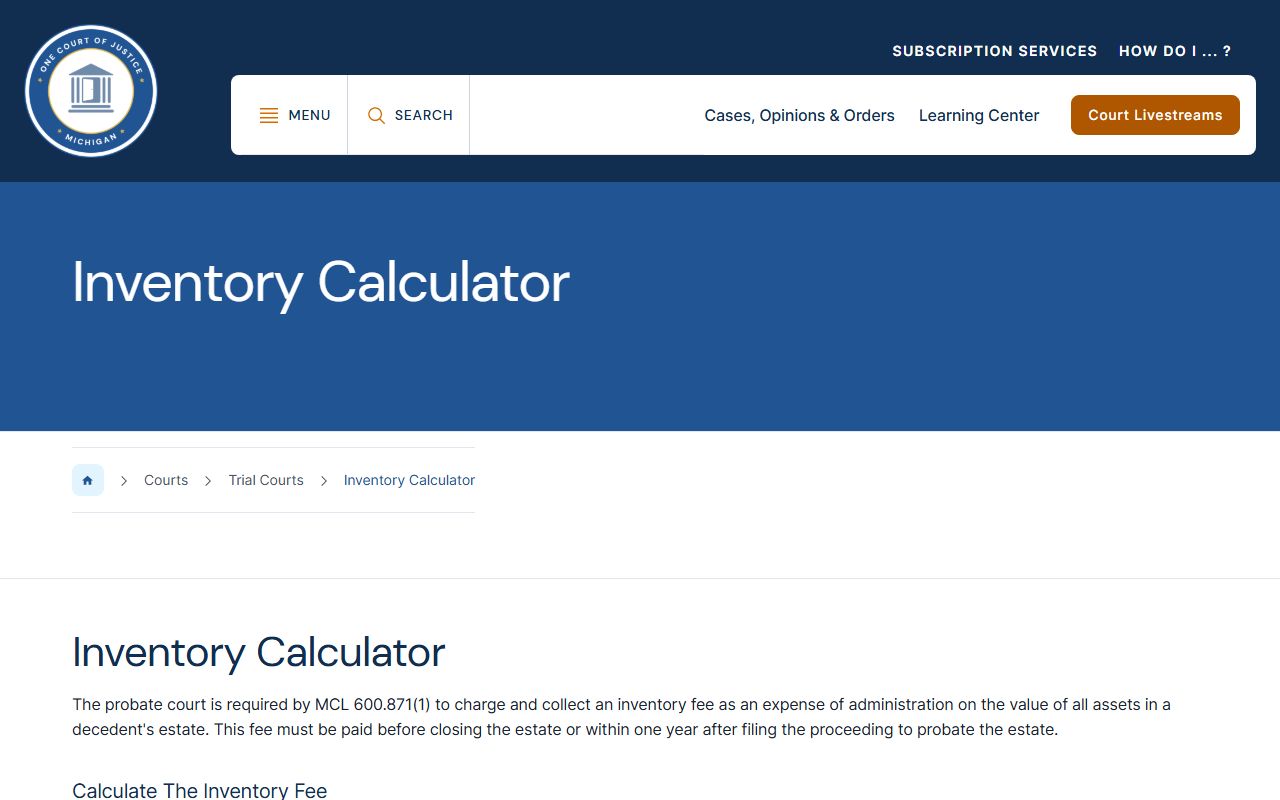
Running the calculator before a hearing helps an estate representative budget the inventory fee alongside the copy charges in the table below.
| Item | Amount |
|---|---|
| Will deposited for safekeeping | $25 |
| Estate inventory fee | Use the Michigan Courts inventory calculator |
| Small estate value limit (2026) | $53,000 or less; confirm the current amount |
| Normal court copy | $2 per page |
| Certified court copy | $10 plus $1 per page |
| Exemplified court copy | $10 plus $1 per page |
Public case documents are not posted online, so order copies through the records channel the same way you would for other Washtenaw County court records.
Steps in the Washtenaw County Probate Process
Opening an estate follows a set order. The path runs from confirming venue to closing the file. Fees, notices, and forms all fall into place along the way. The walkthrough below reflects the county's own guidance for a typical estate.
- Determine whether the decedent lived in Washtenaw County or owned property requiring local probate.
- Decide if the estate qualifies for a small estate, informal, or formal process.
- Use the SCAO probate forms and the Washtenaw Probate Court estate pages.
- File with the Probate Court at 101 E Huron Street, Room 1104.
- Pay the filing and inventory fees, calculating the inventory fee with the Michigan Courts calculator.
- Provide the required notices, death certificate, will if one exists, inventory, and accountings.
- Request copies through the Trial Court records or Probate Court channels, depending on the document.
Restricted Washtenaw County Probate Records
Not every probate file is open to the public. Mental health proceedings involve sensitive treatment and commitment issues, so they stay restricted. The Probate Court handles these cases, but the details are not general lookup material and are not released over the phone.
Some guardianship and conservatorship records also carry protected details, especially where a minor or a health condition is at the center of the case. Estate files are more often public, though a judge can seal parts of any file. When a record is restricted, only authorized parties or someone with a court order may view it.